(Ceylon Today)
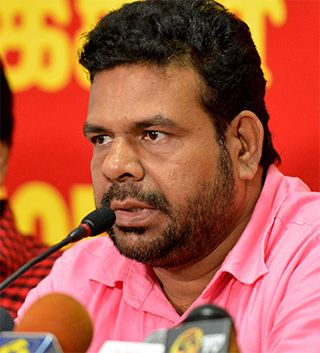 This week trade union talk is about farmers who are an important segment on the labour force of the country. Ceylon Today interviewed the President of the All Ceylon Peasants Federation (ACPF) Namal Karunaratne who spoke of issues concerning farmers.
During the interview, Karunaratne said that although there is a certified price for paddy which is higher than the market price, only the government paddy stores purchases paddy at that price. He noted, only around 5 per cent of total paddy produced is bought by government paddy stores. As a result of that most of the paddy is sold at a very low price. Even the paddy bought by the paddy stores, is later sold at a very low price. Although the price of paddy comes down, the price of rice is never reduced. There are few wealthy and powerful businessmen who control rice prices.
ACPF suggests reducing the cost of production. According to estimates of the government the cost of production per kilo of paddy is approximately
Rs 33. He pointed out that the support of the government to reduce the production cost of paddy would benefit farmers as well as consumers.
Following are excerpts of the interview:
?: More often than not farmers in Sri Lanka are faced with issues; what are the burning issues faced by farmers these days?
A: There are a lot of issues faced by farmers these days. Paddy farmers had to sell paddy at a very low price as the price of paddy had come down. The government intervention in paddy purchasing is not sufficient. Paddy farmers cannot even cover the production cost by selling paddy at the market price. At present the price of a kilo of paddy is Rs 26 and it is likely to go down by next month when harvesting takes place. Meanwhile, big onion farmers too are facing issues due to the high cost of production and the low selling price. The fate of the vegetable farmers in the up-country is pretty much the same. The high price of fertilizer has affected them badly. Very soon soya farmers will face the same issue.
These issues are nothing new. Farmers have been facing these issues over the years, yet the politicians have turned a blind eye to their plight.
?: When you say that farmers do not receive a sufficient price for their produce, it also indicates that by the increase of the price of such produce as rice, farmers should receive more. In that case, the consumers will have to pay more and the cost of living would go up. How do you suggest balancing the two?
A: We suggest reducing the cost of production. According to government estimates the cost of production per kg of paddy is approximately Rs 33; this is a pretty outdated estimate. The production cost is higher than that. However, as I noted before the selling price of a kg of paddy is only around Rs 26. in that context, we ask the government to take measures to reduce the cost of production so that the consumers too will get rice at a lower price; that way the consumers’ interests as well as producers’ interests are ensured.
At present, there is a certified price for paddy which is higher than the market price. However, only the government paddy stores purchases paddy at that price. Only around 5 per cent of the total paddy produced is bought by the government paddy stores. As a result of that most of the paddy is sold at a very low price. Even the paddy bought by the govt paddy store is later sold at a very low price. Although the price of paddy comes down, the price of rice is never reduced. There are few wealthy and powerful businessmen who control the price of rice. These businessmen are affiliated to politics too. They keep a profit around Rs 15 for each kg of rice and the farmers as well as consumers pay for it. It is in that context, that we call for strong government intervention.
?: What are your suggestions to address the issues faced by farmers; what specific measures should the government take?
A: As I told you the production cost has to come down. For that production subsidies should be given to farmers and a certified price should be imposed on paddy, applicable to everyone. The government should take control. Rice Research and Development Institute, was established for that very reason of protecting farmers and consumers.
We suggest providing fertilizer subsidies and machinery at lower prices and also providing relief. It should be noted that most farmers do not get a high income. Providing these subsidies is not a one way transfer. The domestic food production in a country is very vital and it is the job of the government to promote it. It is in the national interest of protecting domestic industries and with the long term objective of gaining self sufficiency.
?: Agriculture as a percentage of the GDP has declined over the years; farmers are moving away from agriculture as well; how do you view this scenario?
A: Actually, steps taken by successive governments forced farmers to leave agriculture, which is bad decision making, given that domestic food production is very vital to the economy. Recently, the Finance Minister had said that paddy farming is not that important and it is cheaper to import rice from abroad. So far the government has not claimed that it is a personal view of the minister and not of the government. This government appears to be of that stance and their attitude towards paddy farming is a negative one.
The policy of the government is to discourage paddy farming. Paddy cultivation is affiliated with the culture of the country too. In addition, in a recent statement by the Agriculture Minister Duminda Dissanayake he claimed that the government wants to take land off agriculture. All of the actions are aimed at discouraging farmers. The cost of fertilizer is high; cost machinery is also high, which force farmers to leave agriculture.
The Minister of Irrigation claimed that the space used for agriculture should be reduced. He said one hectare will be taken away from agriculture. At present, every farmer is faced with issues. Sadly, the new generation distance themselves from agriculture. The government has a master plan to buy lands from farmers and sell it to the private sector.
During this year, nearly 250,000 farmers have left paddy cultivation. In fact they were forced to leave agriculture by the government; through not supporting them in their efforts. Water was not provided to farmers and their issues are ignored. Each year a lot of rice is imported. The government is lying; they have no intention of developing the agriculture sector.
?: Efficiency in agriculture seems very low; while nearly 30 per cent of the labour force is in agriculture. The contribution from agriculture to the GDP is only 10 per cent. What are your views on that?
A: It is true that agriculture is very labour intensive in comparison to production. As you said, we too have identified that as a concern. However, the issue is the government’s negative attitude towards agriculture. The government had claimed that there can be excess production of paddy; and the labour involved in paddy is of no use. However, it should be noted that the job of the government is to make ways for the excess produced to be exported and develop the agriculture sector instead of having a negative attitude towards it. People have a lot of respect for farming and it is affiliated with age old culture. The government seems to have totally forgotten it. We cannot forget the culture that is affiliated with farming.
The government needs to provide farmers with new technology so that the productivity of the agriculture sector can be increased. The productivity in the agriculture sector is very low in Sri Lanka in comparison to many other countries, the harvest per square metre is very little and that can be increased by introducing new types of seeds as well as new farming techniques. However, such actions were not taken by the government. There has to be an attitudinal change in the leaders regarding agriculture.
?: There are talks about using information technology to develop the agriculture sector. What are your thoughts on it?
A: As we see there are a lot of ways in which information technology can be used to develop the agriculture sector. However, as I told you the major issue is with the government attitude. As long as the government does not have a positive attitude towards the agriculture sector, no progress will take place. Not only information technology, there are many latest technologies that can be used to develop agriculture, but it requires effort from the government.