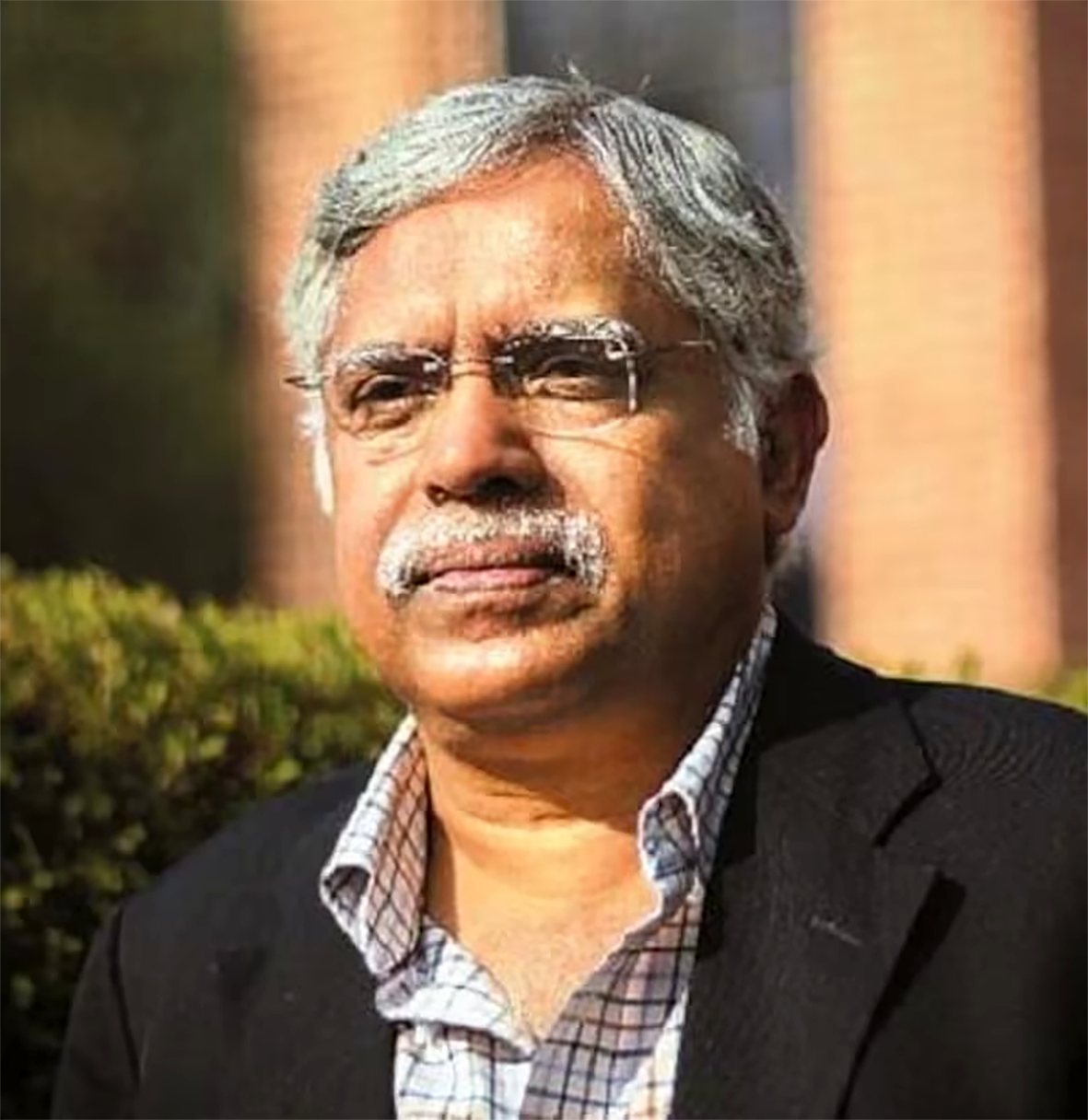
[We publish here an interview carried out by ‘LEFT’ magazine with Prof C.P. Chandrasekhar as it has a timely significance at the current time. Prof C.P. Chandrasekhar, a Senior Research Fellow, was attached to the Centre for Economic Studies and Planning, Jawaharlal Nehru University, New Delhi, served as Visiting Senior Lecturer, School of Oriental and African Studies, University of London; Executive Editor of Deccan Herald Group of Publications Bangalore, Consultant to the Bureau of Industrial Costs and Prices, Ministry of Industry, Govt. of India, and Research Associate at the Centre for Development Studies, Trivandrum.]
 Question: Sri Lanka declared its bankruptcy on the 22nd of April, 2022. Nevertheless, SL had sent the letter of intent to the IMF even before this. There was a big emphasis from one set of economists, business circles, bankers and media that there were no options for Sri Lanka other than seeking the IMF bailout. Some argued that since the “IMF is the lender of last resort”, there is no harm in seeking its help.
As per your analysis of the Sri Lankan economic crises, specifically debt crises, what were the alternative paths Sri Lanka could have stepped in without jumping to IMF?
Answer: It was not surprising that Sri Lanka was in talks with the IMF before the crisis actually broke. The elites wanted a solution dictated by the IMF. Given the huge resort to external commercial borrowing by the Rajapaksa regime, the damage inflicted by the pandemic on Sri Lanka’s foreign exchange receipts, and the speculation induced rise in energy and food prices following the Ukraine war, it was clear that Sri Lanka would not be able to meet its external debt commitments. The default only signalled that the inevitable had happened.
What needs to be noted is that this dependence on external debt, while carried to excess by unscrupulous politicians, was to an extent unavoidable given Sri Lanka’s long history of relying on balance of payments support from the IMF, in return for which it implemented policies that included liberalization of trade and removal of controls on inflows of foreign financial capital. That is, while the Rajapaksas worsened the balance of payments situation, IMF-inspired policies made the situation bad in the first place.
Given this historical role of the IMF, going back to the IMF to resolve the debt crisis was counterproductive. It was clear to both bilateral creditors as well as private creditors and holders of sovereign bonds that Sri Lanka was not in a position to meet its debt service commitments, and that they(the creditors) would have to accept a “hair cut” or a reduction in the value of their credit assets through multiple means: some debt write off, some extension in maturity periods and some reduction in interest rates on remaining debt. Bilateral creditors were already engaged in such adjustments, and without their willingness to do so, the IMF’s programme would not have taken off. Private creditors had already earned immense amounts from Sri Lanka, since the terms of debt were structured to yield many multiples of the original loans. On the other hand, the secondary market for Sri Lankan foreign currency bonds, where the latter were being sold at a discount of a few cents for every dollar of debt, indicated that foreign creditors were in the know of the current value of debt. If the Sri Lankan government had held out and negotiated a haircut, these creditors would have been more than willing to settle for less. And such settlement could have been reached without accepting in return for a small amount of IMF support a programme that is heaping and will continue to heap many miseries on Sri Lanka’s poor and middles classes, who had little role in precipitating a crisis.
Question: Regarding IMF, the household word is “Debt Trap”. What is the difference between “Burden of Debt” and “Being trapped in Debt”?
How are IMF programmes designed to push countries into these perpetual debt traps?
Answer: Debt is a burden because it has to be serviced, and foreign currency debt is even more of a burden since hard-earned and scarce foreign exchange will have to be diverted to pay off that debt. A debt trap is a situation where so much debt has been accumulated, with borrowing partly driven by the need to service past debt, that there is no way, even after much sacrifice, to reduce that debt to sustainable levels. Rather, to stay afloat, debt-trapped countries will have to keep enhancing the volume of outstanding debt, till crisis strikes.
The IMF cannot prevent such crises in the future, and can at best offer band-aid dolutions. IMF programmes, which bring in a small amount of foreign exchange to temporarily ease the balance of payments problem, require governments to liberalize trade, leading inevitably to rising trade and current account deficits. This requires greater reliance on foreign capital, including foreign debt. Since IMF-inspired policies also liberalize capital inflows, or increase the ease with which foreign capital can be accessed, they encourage governments to ignore external deficits, since they can be financed with foreign borrowing in the short run, though that increases the debt burden. This continues under IMF tutelage till debt once again becomes unsustainable.
Question: The IMF loan agreement of Sri Lanka 2023 March,
Would it overcome the economic crises of Sri Lanka?
Would it be possible to solve the Debt burden of Sri Lanka, as it declared?
Some stipulated targets in the IMF programme look illusionary (for example – expectations of FDIs) and self-contradictory (e.g.300% energy price hikes and economic growth!). Are the main economic and debt restructuring targets mentioned in the IMF programme realistic?
Answer: As mentioned, resolving Sri Lanka’s debt crisis requires going through a minimum of two steps. First, it is necessary to reduce the volume of outstanding debt through a process of restructuring. There is no guarantee that foreign private creditors would easily accept a settlement in which they lose some of their super profits, just because the IMF has given Sri Lanka the promise of a clean chit if it adopts recommended policies and meets suggested targets. Those policies may prove difficult to implement and some targets that call for deep austerity among a population that is already economically devastated would remain unrealized. The growth and macroeconomic (especially budgetary) targets are not just in conflict, but completely unrealistic.
Second, it is necessary to reduce dependence on debt, by reducing balance of payments deficits. While this may partially happen because of the post-pandemic and post-crisis recovery in foreign exchange receipts in areas like tourism, for example, a significant reduction in the import bill is needed. The best way to ensure this is by reducing non-essential imports by the elites and the super-rich. But since these sections are not responsive to price increases, restraining their consumption requires physical controls on luxury imports of all kinds. But with its obsession with trade liberalization, that is not what the IMF would have. Rather it implicitly (and on occasion explicitly) seeks to curb necessary imports, reducing demand for such imports (including essentials like food and energy) by imposing austerity on and contracting income of the broad masses. That contraction is to be ensured through many routes: reduced government expenditure (including on social security and welfare), sharply increased energy prices, devaluation of the Sri Lankan rupee that renders essential imports more expensive, and most recently, a squeeze on the earnings of pensioners, by restructuring domestic debt owed to them by the government to create “fiscal space”. The impact of this on the already immiserised poor and middle classes cannot but be devastating. But, it is unlikely that this will help correct the balance of payments vulnerability, as the rich continue to demand and consume imported luxuries of various kinds, and even converting their wealth into hard currency to be held abroad.
Question: What will be the IMF programme’s economic and social consequences if implemented fully?
Answer: I referred to the economic consequences earlier, with worsening conditions of life for the poor and middle classes and those in the informal sector. On the other hand, the cost that would be borne by foreign lenders and the rich is likely to be buffered considerably, since there is no effort to impose additional taxes on the incomes of the rich and on their wealth, to generate the revenues that will allow the state to support those being affected adversely by austerity.
It is the social consequences of this that can be frightening. As the “aragalaya” protests revealed, there is much anger among the people of Sri Lanka against the elites that can break into spontaneous struggles. There has been a respite in those struggles partly because of repression and partly because the people had been persuaded that the solution to Sri Lanka’s problems was an adjustment programme designed and overseen by the IMF, which will bring creditors to the table and reduce the debt burden. Those promises will not be kept and anger would be fuelled again, that can lead to social disruption. The direction politics will take in those circumstances is unclear. It may force a shift to a more progressive and egalitarian programme pursued by a new government with social sanction from the people. But experience elsewhere indicates that it can also lead to a turn to the right, with nationalist, revanchist and communal ideologies dividing society and pitting sections against each other. That will add to the economic crises, heaping misery on most people.
Question: When we study the recent history of IMF loans to many other countries, we experience a lot of failed stories, such as Argentina, Greece, Lebanon, Ghana, etc. Even though any institution can make wrong decisions, we see the
IMF’s track record is filled with many failed stories – failed in the sense of borrowing country. In this context, what are the DNAs in IMF cells that always kill the Patient?
Answer: The DNA, if you want to call it that, is that as the voting structure and the policy template of the IMF makes clear, it is an institution that serves the interest of global capital, especially global financial capital, with backing from the US and its allies. It therefore is primarily geared to protecting those interests, rather than to delivering sustained and sustainable development in low and middlle income countries, that can reduce unacceptable levels of international inequality.
Question: Here in Sri Lanka, some argue that IMF loans to India in 1991 and IMF loans to South Korea in 1998 as success stories. You are one of the few economists who have thoroughly studied the Asian Economic crises. Even you and Prof Jayati Ghosh had authored a book on Asian Financial Crises – ‘Crisis as Conquest: Learning from East Asia’. Also, ‘Neoliberal Economic reforms in India’ and ‘The market that failed: neoliberal economic reforms in India’.
Would you please share your findings and conclusions of IMF Deals of India and South Korea and the impacts of neo-liberal reforms in India?
Answer: The IMF’s role in South Korea in 1997 or India in 1991 were definitely not instances of success. The adjustment strategy imposed on South Korea facilitated the penetration of foreign capital, especially foreign finance, into a country whose capitalists were challenging western dominance of global markets. Post-adjsutment South Korea lost the dynamism that characterized it in the decades of the 1970s to the 1990s. In India’s case, the promise that IMF style “reforms” would make India a global manufacturing hub and export success has been belied. It has also led to huge increases in inequality in the country. If these countries are among the better performers in the world today, it is not because of but despite the IMF adjustment programmes.
Question: As we exposed the huge failures of IMF programmes, it is always an unalienable responsibility of the anti-imperialist Left to provide a viable, scientific, of course, people-friendly LEFT Alternative Economic programme which can substitute IMF imposed programmes. Would you propose some key proposals which can be included in a LEFT alternative programme and implemented by a Left government with a People’s Mandate?
Answer: This is not the space to do that, since a cursory listing would not do justice to the immense work that has gone into designing alternative economic programmes by the Left. Suffice it to say that there is enough on the table for a progressive government to take up and implement, depending on national circumstances. It is not that there is no alternative. The problem everywhere is the absence of the environment and a state that has the ability to implement an appropriate programme, that improves well-being, protects the environment and strengthens democracy.
Question: The final question we would like to know from you about the future of the global economy with this phase of toxic financialization and many more like Sovereign debt crises, banking collapses, monopoly control over all most all human needs wants, and desires, unemployment, economic refugees, mass migration of professionals from developing countries, corruption etc etc.
Are we heading to a fully blown crisis bigger than 2008?
Will de-dollarization or a new global currency be a solution for at least a decade or two, as some are optimistic?
Answer: As the recent banking crises in the US and Europe illustrated, financial fragility of a kind that can precipitate a major crisis still pervades in the so-called ‘advanced nations’. If they managed to stave off a depression in 2008 and have not succumbed to another severe crisis as yet, it is because of massive intervention by governments and central banks in these countries. Those interventions have broken all rules of the capitalist game and of a ‘rules based international order’—rules prescribed to developing countries and to new economic powers like China. Big capital and global finance have been offered mid-boggling support through transfers from the State, even when minor relief efforts for the world’s poor is dubbed as populist and wrong. But a breakdown of rules implies that capitalism can no longer be governed in mutually agreed ways that can ensure stability. Another crisis is inevitable. But, as I said earlier, there is no guarantee that the crisis would lead to progressive and sustainable alternatives. That depends on the people and how they mobilize themselves.